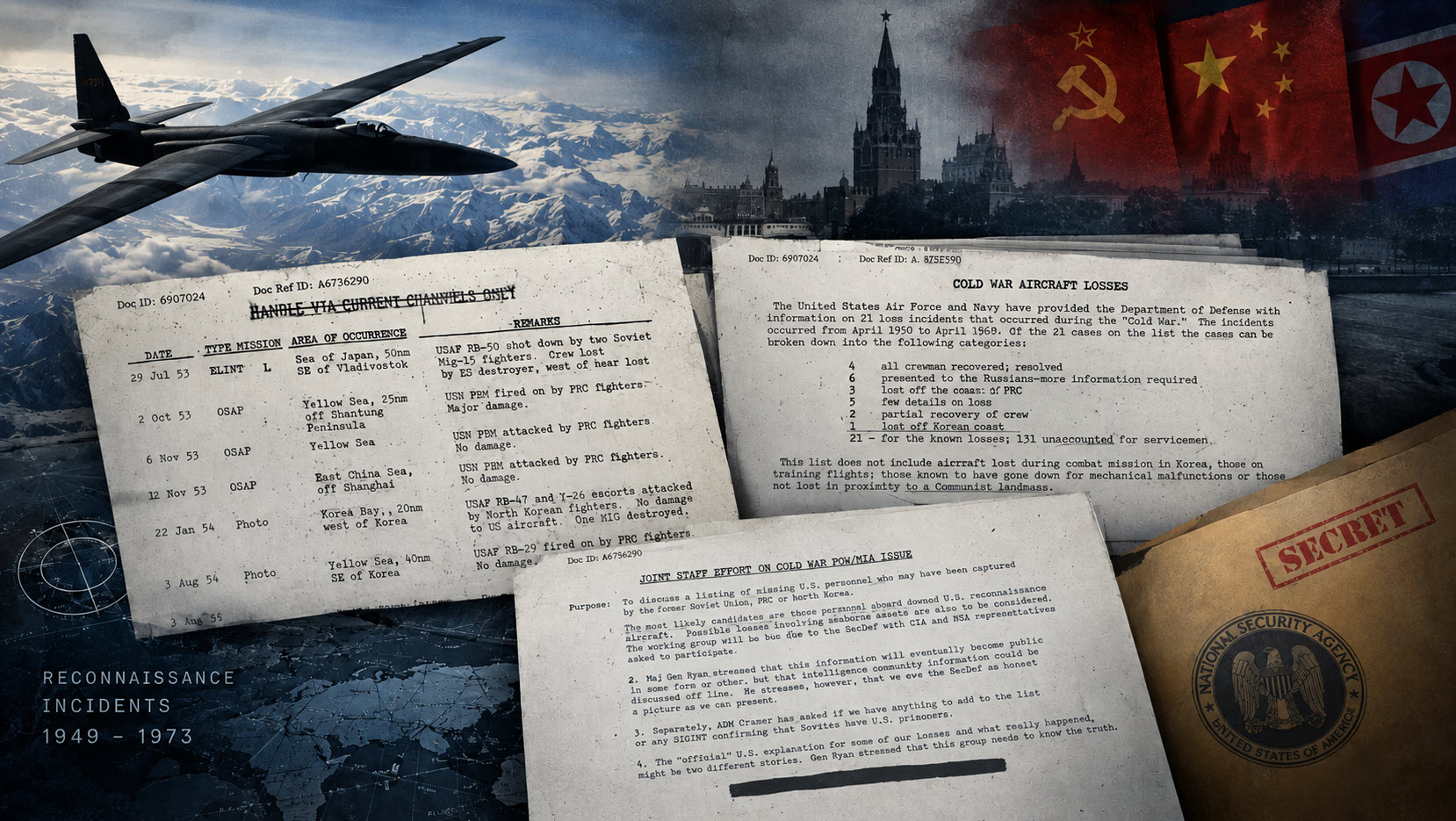

Records released by the National Security Agency to The Black Vault in September 2025, and now being published online by The Black Vault, provide additional details about a 1992 Pentagon effort to examine Cold War reconnaissance losses and determine whether missing American personnel may have fallen into the hands of the Soviet Union, China or North Korea.
The records include historical summaries of U.S. reconnaissance incidents and aircraft losses, along with a June 1992 memorandum concerning a Joint Staff effort to examine Cold War POW/MIA cases. Much of the history of the underlying reconnaissance incidents has been documented previously. The significance of the material is instead found in the internal Pentagon discussion surrounding those losses and the questions officials were examining decades later.
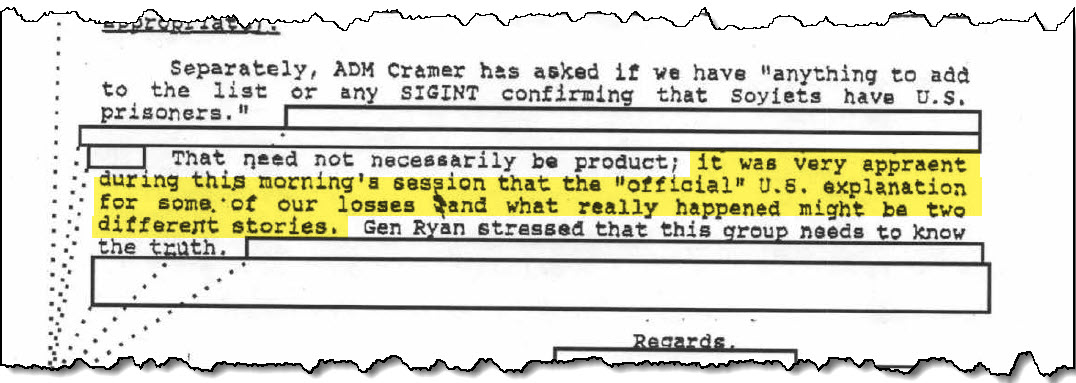
Among the most notable passages is a statement that, for some losses, the government’s “official” explanation and what actually happened could represent “two different stories.”
The documents do not establish that missing U.S. servicemen survived in foreign custody. Nor do they establish that official explanations for particular aircraft losses were false. They document questions Pentagon officials were examining in 1992, and some portions of which remain classified today.
A 1992 Joint Staff Review of Cold War POW/MIA Cases
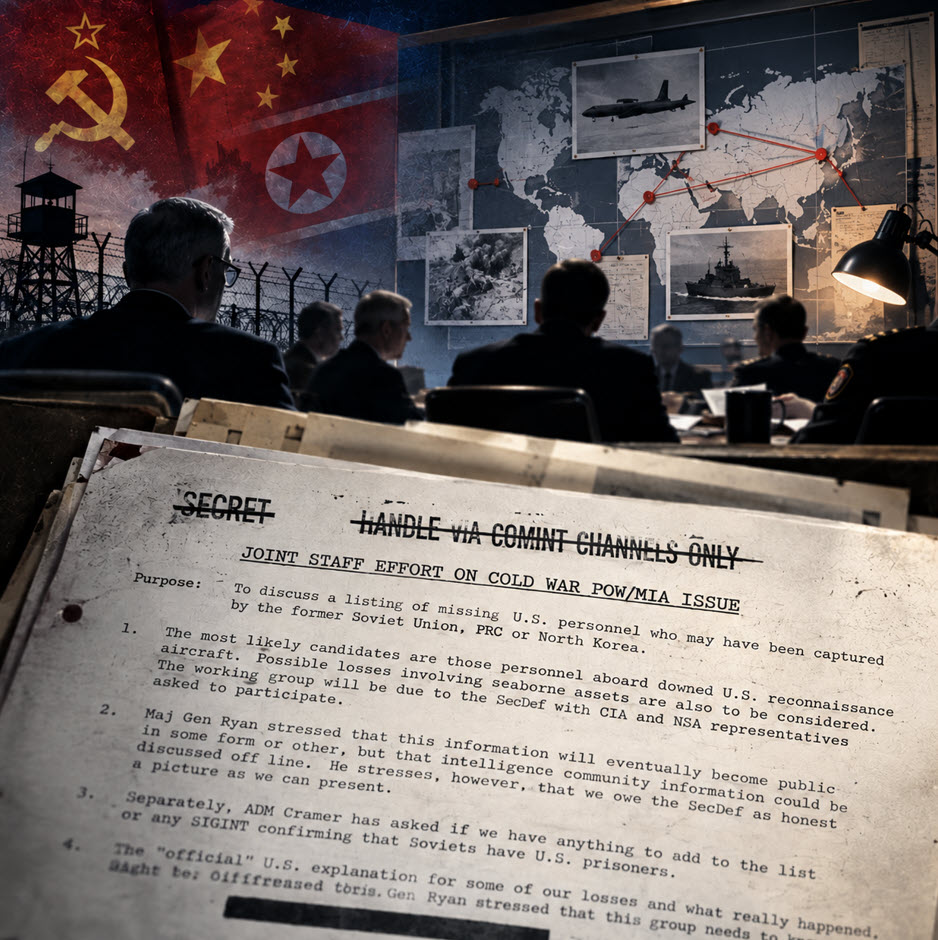 One of the most notable records is a memorandum dated June 17, 1992, titled “JOINT STAFF EFFORT ON COLD WAR POW/MIA ISSUE.”
The memorandum describes a meeting chaired by Maj. Gen. Ryan concerning a task from the Secretary of Defense. According to the document, the effort involved:
“a listing of missing U.S. personnel who may have been captured by the former Soviet Union, PRC or North Korea.”
The memorandum states that downed U.S. reconnaissance assets represented the “most likely candidates,” although possible seaborne losses were also under consideration. CIA and NSA representatives were asked to participate and contribute information.
According to the memorandum, Ryan advised participants that information developed through the effort eventually “will be made public” in some form. Intelligence-community information could be discussed separately.
The document records his position:
“we owe the SecDef as honest a picture as we can present.”
The memorandum also records a separate request from Adm. Cramer:
“Separately, ADM Cramer has asked if we have ‘anything to add to the list or any SIGINT confirming that Soviets have U.S. prisoners.'”
“The ‘Official’ U.S. Explanation”
The memorandum becomes particularly notable in its description of what information officials wanted examined.
It states:
“the ‘official’ U.S. explanation for some of our losses and what really happened might be two different stories.”
The next sentence reads:
“Gen Ryan stressed that this group needs to know the truth.”
The document does not identify in that passage which specific losses prompted the observation. It also does not explain how an official account might have differed from what actually occurred.
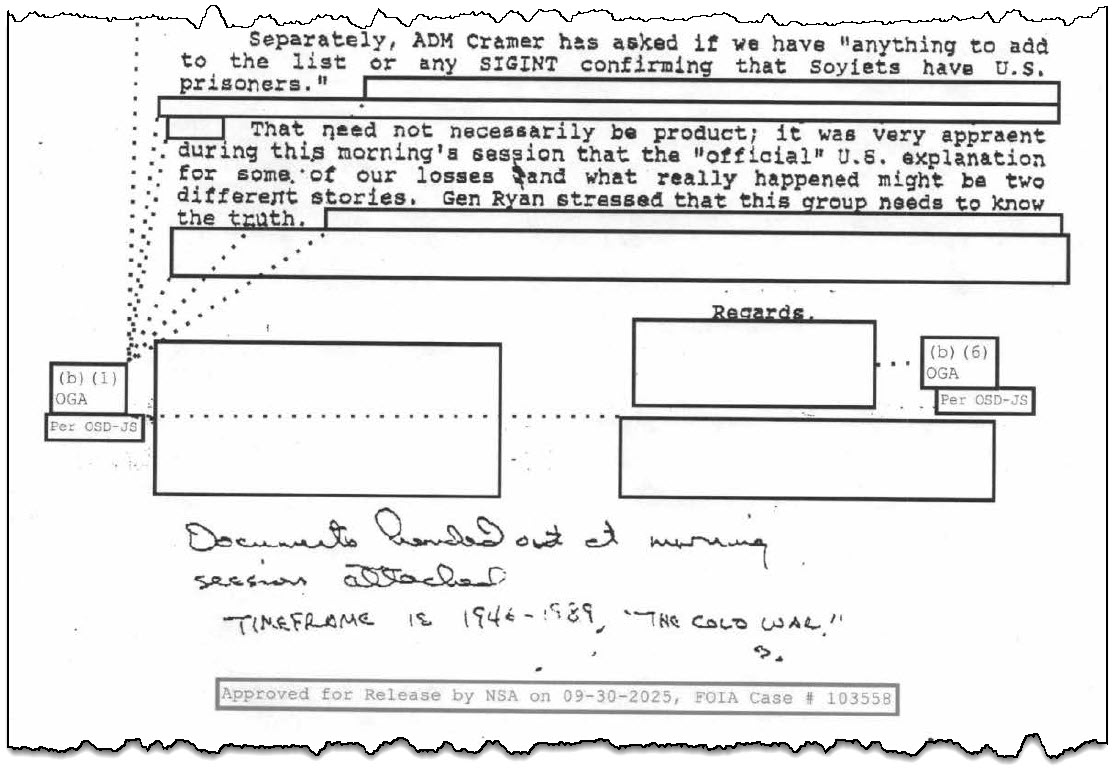
Material immediately following this discussion remains withheld in the version released to The Black Vault.
21 Aircraft Loss Incidents and 131 Unaccounted-For Servicemen
Another record, titled “COLD WAR AIRCRAFT LOSSES,” summarizes information supplied by the Air Force and Navy concerning 21 loss incidents between April 1950 and April 1969.
The document separates those incidents into several categories. Four involved cases in which all crew members were recovered and the matter was considered resolved. Six had been presented to the Russians and required additional information. Three involved losses off the coast of the People’s Republic of China. Five had few details available concerning the loss. Two involved partial recovery of crews, and one involved a loss off the Korean coast.
The document then states:
“For the known losses: 131 unaccounted for servicemen.”
The accompanying table identifies Cold War aircraft losses involving a number of platforms, including the Privateer, B-29, P2V, RB-50, C-130, U-2 and RB-47.
A Broader History of U.S. Reconnaissance Incidents
The records also contain the Airborne Reconnaissance Incident History that was at the center of The Black Vault’s original FOIA request.
A Joint Staff Action Processing Form dated June 5, 1992, describes the purpose of the paper as providing a summary of approximately 30 airborne reconnaissance missions during the 1949-1960 period that resulted in international incidents and/or the loss of manned aircraft.
According to the document:
“During the period 1949-1960, there were 32 airborne reconnaissance missions flown which resulted in international incidents and the loss of 13 manned aircraft platforms.”
The pages that follow provide a chronology of encounters involving U.S. reconnaissance aircraft and Soviet, Chinese and North Korean forces.
The release also includes a continuation covering 1961 through 1973.
That section states that after centralized management of reconnaissance activities began in 1960, there was a “significant decrease in reconnaissance-related incidents.” It identifies three losses during the later period: the U-2 shot down over Cuba during the Cuban Missile Crisis in 1962, the capture of USS Pueblo off North Korea in 1968, and the EC-121 shot down over the Sea of Japan in 1969.
The accompanying chronology documents additional encounters involving U.S. reconnaissance platforms and foreign military forces during the 1960s and early 1970s.
Some of the Record Is Still Classified
 Despite the age of both the Cold War incidents and the 1992 review, the FOIA production released to The Black Vault is not complete.
In its September 29, 2025, response, NSA stated that it had “no objection to the release of the NSA equities.” Other information, however, was referred to the Office of the Secretary of Defense-Joint Staff, or OSD-JS (now the Office of the Secretary of War-Joint Staff).
According to NSA, OSD-JS determined that the information remains properly classified under Executive Order 13526 and continues to warrant classification at the SECRET level.
The response states that disclosure:
“could reasonably be expected to cause grave damage to the national security.”
NSA therefore withheld the information under FOIA Exemption (b)(1). Other material was withheld under Exemption (b)(6) to protect personal privacy.
One of the OSD-JS deletions occurs directly after the 1992 memorandum’s discussion of the possibility that an “official” explanation for some losses and “what really happened” could be different.
The historical summary covering 1961 through 1973 also contains information withheld by OSD-JS.
The records were released to The Black Vault in September 2025 after a FOIA request specifically sought material excluded from an earlier NSA release as “non responsive.” They are now being made available online as part of The Black Vault’s document archive, preserving both the historical reconnaissance records and the additional context surrounding the Pentagon’s Cold War POW/MIA review.
###
Document Archive
 FOIA Case 103558 Release Package [15 Pages, 2MB]
 Loading...
 Reload document
 Open in new tab


