


 A collection of eight National Security Agency technology forecasting studies, spanning topics from privacy and anonymity to brain-network interfaces, advanced antennas and terahertz electronics, has been released through the Freedom of Information Act after a request that dated back to May 25, 2011.
The original FOIA request sought ten documents described as “Point Forecasts issued by the Futures Intelligence Team.” The requested studies covered solid-state lighting for wireless communications, human interaction with computer networks, antenna technology, energy storage and ultrathin electronics, post-Moore’s Law materials, terahertz microelectronics, harvested power, bio-inspired computing, privacy and anonymity, and position-location technologies.
The documents requested sought the following titles:
- Using Solid-State Lighting for Wireless Communications
- The Human Side of the Net
- Antenna Technologies
- Point Forecast for Small Energy Storage and Ultrathin Electronics
- What’s Beyond Moore’s Law
- Terahertz Solid-State Microelectronics
- Harvested Power and the Need
- Bio-Inspired Computing
- Privacy and Anonymity
- Position Location
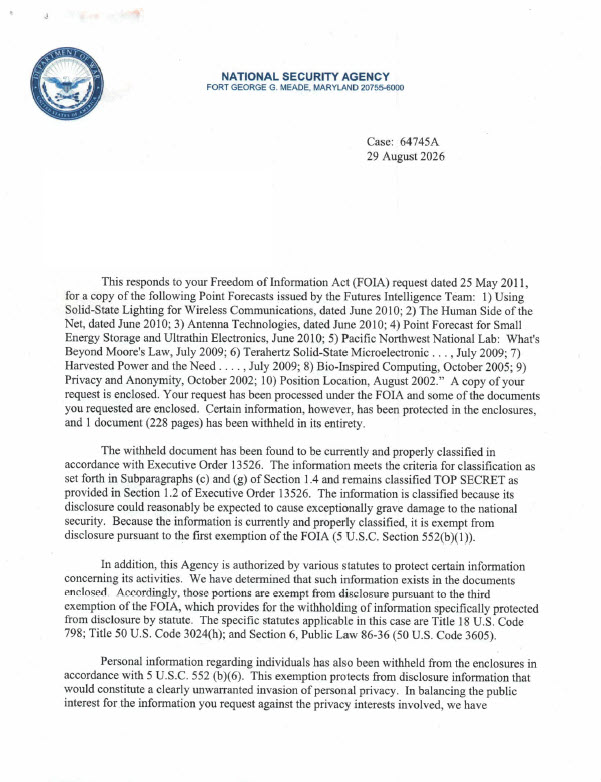
NSA’s response, dated August 29, 2026, came more than 15 years after the request was filed. The agency stated that some responsive documents were being released with information withheld and that one 228-page document was withheld in its entirety. NSA did not identify that document by title.
According to the response, the 228-page document remained “currently and properly classified” under Executive Order 13526, resulting in its withholding under FOIA Exemption 1. NSA also cited Exemption 3 for information protected by federal statutes, specifically Title 18 U.S.C. §798, Title 50 U.S.C. §3024(i), and Section 6 of Public Law 86-36. Personal information was withheld under Exemption 6. The agency further stated that the Department of Energy requested withholding of certain information under Exemptions 6 and 7, with those portions identified as “OGA,” or Other Government Agency.
The eight studies now archived by The Black Vault correspond to eight of the ten titles specifically identified in the 2011 FOIA request. The two requested titles not represented in the released collection are Bio-Inspired Computing and Position Location. The available FOIA response does not identify which requested title corresponds to the 228-page document withheld in full, so it cannot be established from the records whether that document was Bio-Inspired Computing, Position Location, or both. Accordingly, the record establishes only that ten titles were requested, eight are represented in this release, and one unidentified 228-page responsive document was withheld in its entirety.
A Window Into NSA Technology Forecasting
Although the subjects vary considerably, the documents belong together for a specific reason: they were produced as forward-looking assessments intended to examine technologies that could affect national-security missions.
One of the earliest records in the collection, the 2002 Privacy and Anonymity study, provides unusually direct context for that effort. Its preface states that NSA’s Technology Forecasting Program was established to “anticipate the impact of advancing technologies on NSA’s mission.” It describes a process under which analysts examined emerging technologies, market trends and research activity to identify technologies that could affect future operations.
Later reports show national laboratories playing a significant role in that process. Several were produced by Sandia National Laboratories for NSA’s Research Transformation activities, while others were prepared by Pacific Northwest National Laboratory. The documents often combine scientific literature reviews, technology assessments, commercial-market analysis, international research comparisons and forecasts of capabilities several years into the future.
What emerges is not a single research program devoted to one technology. Instead, the papers provide snapshots of what government technology analysts considered potentially consequential at different points between 2002 and 2010: how humans might interact directly with networks, how tiny autonomous devices could power themselves, whether visible light could carry wireless data, what might replace traditional semiconductor scaling, how terahertz systems could be miniaturized, and how advances in antennas could reshape sensing and communications.
Below are the eight released records.
The Released Documents
 Privacy and Anonymity: A Technology Forecast, 29 October 2002 [44 Pages, 11.671MB]
This NSA Information Assurance Research Group forecast examines privacy and anonymity at a moment when Internet use, electronic commerce, digital communications and government surveillance were rapidly expanding. Rather than treating privacy and anonymity as technologies themselves, the report examines them as rights and policy concerns being reshaped by technology. Written shortly after the September 11 attacks, it places particular emphasis on the tension between personal privacy and national security. The document reviews U.S. and European privacy law and discusses technologies with significant privacy implications, including Wi-Fi, Secure Socket Layer, public-key infrastructure, virtual private networks, intrusion-detection systems, biometrics, Microsoft’s Passport and Palladium initiatives, anonymous remailers and Internet anonymizers.
The report also addresses the issue specifically from NSA’s perspective. It acknowledges a fundamental tension between protecting privacy and anonymity and conducting intelligence operations intended to penetrate those protections when directed against authorized foreign targets. The forecast concludes that technological solutions alone cannot resolve privacy concerns and that legal and policy protections will remain important. It also anticipates that improvements in privacy- and anonymity-enhancing technologies could make NSA’s intelligence mission “more challenging and expensive,” while potentially assisting—or complicating—the Agency’s information-assurance responsibilities.
What’s Beyond Moore’s Law: Emerging Research Materials, May 2009 [91 Pages, 26.229MB]
This technical assessment examines what might happen as conventional complementary metal-oxide-semiconductor (CMOS) scaling approaches physical and engineering limits. Rather than assuming that increasing transistor density could continue indefinitely through conventional silicon technology, the report evaluates emerging materials and fabrication techniques that might sustain the historical trajectory associated with Moore’s Law. Topics include advanced lithography, graphene, carbon nanotubes, nanowires, macromolecules, directed self-assembly, spin materials, complex metal oxides, interfaces and heterointerfaces, along with computational modeling and simulation. Its stated objective is to forecast the sustainability of Moore’s Law through 2030 and beyond.
The report develops three broad scenarios: carbon-based nanoelectronics replacing or supplementing silicon; complex metal oxides assuming a larger role in future devices; or silicon remaining dominant while the historical rate of Moore’s Law gradually declines. Its forecast anticipated a difficult transitional period as conventional CMOS scaling weakened before replacement technologies became sufficiently mature. The report identified carbon-based nanoelectronics—particularly graphene and carbon nanotubes—as an important potential route beyond conventional silicon, while explicitly recognizing major unresolved technical problems. Its long-range projections, including terahertz-range single-core performance and trillions of transistors per chip by around 2030, are forecasts made from the technological perspective of the report’s period rather than statements of present-day capability.
Technology Point Forecast: Terahertz Solid-State Microelectronics, April 2009 [109 Pages, 22.913MB]
Prepared by Sandia National Laboratories, this report assesses efforts to develop practical solid-state electronic components operating in the terahertz portion of the electromagnetic spectrum, which it generally defines for its purposes as approximately 0.5 to 5 THz. The document describes terahertz frequencies as occupying a technological gap between microwave electronics and infrared photonics: conventional transistor-based electronics become increasingly difficult at the upper end, while conventional photonic technologies encounter limitations approaching from higher frequencies. The forecast evaluates research aimed at creating compact, manufacturable solid-state sources and detectors capable of closing that gap.
The report contrasts this goal with existing tube-based terahertz sources, which could provide useful performance but carried substantial disadvantages in size, weight, operating voltage, power requirements and mechanical complexity. It cites, for example, a 2.5-THz molecular gas laser developed for NASA’s Aura satellite as evidence that rugged terahertz systems were possible, while noting the substantial engineering expense involved. The forecast therefore focuses on solid-state approaches and assesses competing research directions, technical hurdles, anticipated component requirements and leading research groups worldwide, with an eye toward applications relevant to national security, defense and intelligence.
Overview of Harvested Power and the Need, April 2009 [37 Pages, 12.255MB]
This Sandia National Laboratories report examines “energy harvesting” as an alternative to relying exclusively on stored battery power for miniature sensors, actuators and communications equipment. The report explains that shrinking conventional batteries can sharply reduce practical energy density because packaging, seals and other inactive components occupy an increasing proportion of the available volume. It therefore evaluates methods for collecting energy from the surrounding environment, including photovoltaic, chemical, thermal, mechanical and radio-frequency sources. The document compares the energy densities, conversion efficiencies and practical limitations associated with each approach.
The forecast goes beyond individual energy-harvesting devices by examining the supporting systems required to make them useful. Because harvesters frequently cannot meet the instantaneous power requirements of electronics, the report discusses batteries, supercapacitors and power-management circuitry as load-leveling mechanisms. It also provides short-, medium- and long-term capability forecasts, including the possibility that advances in antennas, rectifiers and low-power electronics could eventually make RF energy harvesting practical across substantial portions of urban environments. The broader forecast is that harvested power would become increasingly important as electronic systems became smaller, more autonomous and expected to operate for longer periods without conventional battery replacement.
Point Forecast for Small Energy Storage and Ultrathin Electronics, March 2010 [59 Pages, 18.380MB]
Prepared by Sandia National Laboratories for NSA Research Transformation, this forecast examines technologies capable of supplying power to increasingly small electronic devices while simultaneously reducing the physical thickness of the electronics themselves. The report surveys ultrathin and printable batteries, battery materials, supercapacitors, mechanical energy-storage systems, radioisotopic power systems and ultrathin semiconductors. Its central concern is the engineering problem created when sensors, communications devices and other electronics become so small that conventional batteries and packaging consume a disproportionate amount of their available volume.
The forecast also tracks international research activity, including work in China, Taiwan, Japan, South Korea, Russia, Australia, France and the United Kingdom. On the electronics side, it examines efforts to thin conventional silicon circuits into flexible structures approximately 5 to 50 micrometers thick, as well as organic semiconductor alternatives. The document connects these advances to applications such as smart cards, wearable sensors and low-profile communications equipment, while emphasizing that reliability, heat dissipation, packaging and energy density remained significant constraints.
Forecasting of Antenna Technologies, March 2010 [38 Pages, 10.651MB]
This Sandia National Laboratories forecast, sponsored by NSA Research Transformation, examines emerging antenna technologies needed to support increasingly capable and miniaturized wireless systems. It concentrates on four principal areas: electrically small antennas, metamaterial-based antennas, advanced antenna-array architectures and new approaches to integrating materials into antenna systems. The report argues that antennas should no longer be treated as an afterthought in system design, particularly as wireless devices are required to support multiple functions while meeting increasingly stringent size, power and performance requirements.
The study evaluates electrically small antennas for applications such as RFID and communications, metamaterials intended to alter or improve electromagnetic behavior, smart and phased arrays, and flexible or mechanically reconfigurable antenna concepts. It also surveys international research and publication activity, including Chinese work in areas such as monopulse systems, RF stealth and radar-absorbing materials. The forecast concludes with short-, medium- and long-term assessments of technical readiness, framing antenna development as an enabling technology for future communications, sensing and other wireless systems rather than merely a peripheral hardware component.
Technology Forecast: Using Solid-State Lighting for Wireless Communications, February 2010 [61 Pages, 15.479MB]
Prepared by Pacific Northwest National Laboratory, this forecast examines whether light-emitting diode solid-state lighting could simultaneously illuminate spaces and function as a wireless communications infrastructure. The underlying concept is visible-light communication: because LED output can be modulated rapidly, lighting fixtures could potentially transmit digital information while continuing to provide apparently continuous illumination to occupants. The report considers both indoor networking and point-to-point optical communications and reviews the rapid development of high-brightness LEDs that was making solid-state lighting increasingly practical.
The report tempers some of the more ambitious expectations surrounding the technology. Earlier projections had contemplated gigabit-per-second data rates and communication over hundreds of meters, but experimental systems, physical modeling and practical engineering constraints had caused those expectations to be revised downward by the time of the study. The forecast evaluates LED performance, modulation, receivers, networking architectures and the relationship between lighting requirements and communications performance. In effect, it examines an early version of what later became widely known as visible-light communications or “Li-Fi”: using existing or future LED lighting infrastructure as an additional medium for transmitting information.
The Human Side of the Net, March 2010 [99 Pages, 27.450MB]
Prepared by Sandia National Laboratories, The Human Side of the Net explores neuroscience and neurotechnology as potential components of future computer networks. The report surveys technologies including EEG, fMRI, MEG, PET, functional near-infrared spectroscopy, transcranial stimulation and other methods for measuring or influencing brain activity. Its central forecasting question is unusually direct: how might humans become “more than metaphorically” part of a network? From that premise, the study examines the possibility of direct input from the brain to a network, biometric encryption and identification based on unique neurological signals, cognitive-state detection, deception detection and direct control of devices.
The report then considers more speculative applications that researchers might eventually pursue if neurotechnology improved sufficiently. These include using the brain as a supplementary processor, “brain onion routing,” outsourcing recognition tasks to human participants, and establishing two-way interaction between the brain and a computer network. Importantly, these concepts are presented as forecast scenarios rather than evidence that NSA possessed or deployed such capabilities. Large portions of the document are redacted under FOIA exemptions, including material withheld under Exemption 7(E), leaving some of the original analysis unavailable in the released version.
Follow The Black Vault on Social Media:


